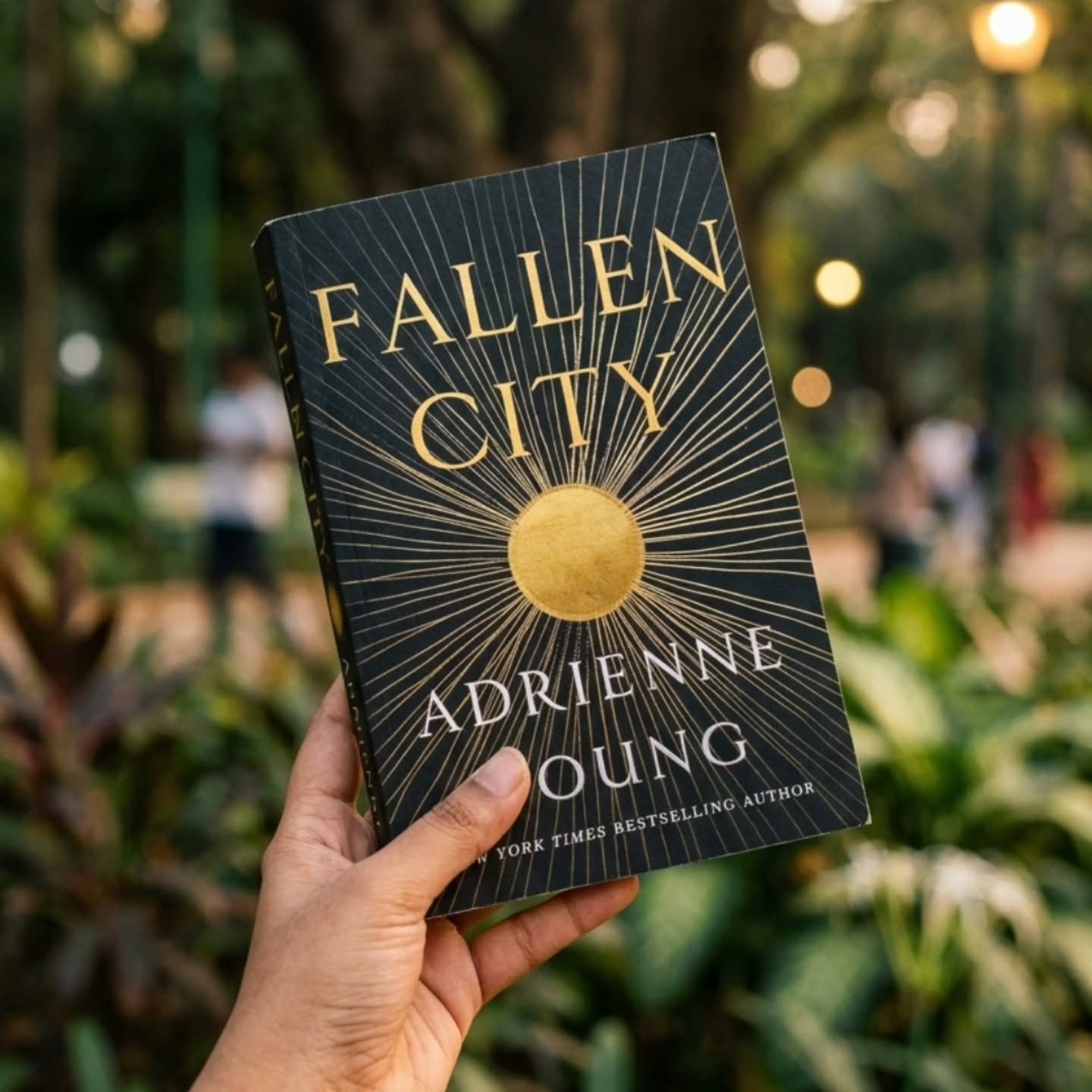
Fallen City
-------------------------------------
Author: Adrienne Young
Published: 2025
Genre: English
-------------------------------------
IBC Editorial Rating: 3.5/5
This book is handpicked by the IBC Editorial Team. If you are an author, publisher, or reader and would like to have a book reviewed by IBC, you may reach us at editorial@indianbookclub.com — we’ll be happy to review it.
-------------------------------------
Editorial Review:
Every revolution begins somewhere quiet — in a back room, a secret meeting, a chain of events that looks, in the moment, like a coincidence. In the fictional city of Isara, where political corruption runs as deep as the gods' influence over mortal lives, two young people are about to become the centre of a story they did not choose. Luca Matius is bound to a family legacy he has not yet decided whether to honour or escape. Maris Casperia is shaped by years of service to the last Priestess of a stolen magic, and carries a vision for her city that her city has not yet earned. Fallen City is Adrienne Young's entry into ancient-world-inspired political fantasy — layered, atmospheric, and built with the deliberate patience of a writer who knows she is constructing a foundation, not a finale.
-------------------------------------
Book Summary:
Luca Matius understands his role. He is the continuation of a family name, its presence in the Forum, its claim on power, its survival beyond the reign of a cruel uncle who will not live forever. It is not a life he chose, but it is the one he has, and he has learned to navigate its demands with the careful pragmatism of someone who knows which walls not to push against. Then his noviceship with the city's Philosopher places him at the centre of something he cannot manage with pragmatism alone. Maris Casperia has spent her life inside the Citadel's inner workings, close enough to power to understand exactly how it operates and exactly who it protects. Her years serving the last Priestess keeper of a magic that belongs to an older, pre-corruption era have given her something dangerous: a different vision of what Isara could be. When she and Luca meet, Young makes clear that this is not simply two people finding each other. It is a convergence that something larger has been waiting for. The plot that follows is built on the architecture of political fantasy at its most considered alliances formed under pressure, secrets surfacing at the worst possible moment, the machinery of power grinding against the people caught inside it. Luca and Maris hatch a calculated plan to shift the city's balance, but when an execution transforms Luca into an involuntary symbol of rebellion, the alliance fractures and the two find themselves on opposite sides of a holy war neither of them intended to start. Young writes with a dual perspective across dual timelines, a structure that rewards patience and reveals its full design gradually. The pacing is deliberate; this is a novel more interested in the political and spiritual architecture of its world than in immediate action, and it is transparent about that priority. The gods are present not as distant mythology but as active participants in the story's design, and the magic system, rooted in the religious structures of the Old War, carries genuine thematic weight even where it is not yet fully elaborated The ending arrives with a momentum that reframes much of what came before, and the unresolved threads it leaves are less frustrating than they are genuinely anticipatory.
-------------------------------------
Key Takeaways:
"Destiny and the cost of divine favour": The novel's most unsettling idea is embedded in one of its most quietly delivered lines — that being chosen by the gods is not a blessing but a warning. Luca and Maris are at the centre of a story being written above them, and Young is honest about what that means for their autonomy. "Corruption and the vision of something better": Maris's political arc is driven not by personal ambition but by proximity to an older, uncorrupted form of power. Her chapters carry the novel's most sustained engagement with what it would take to genuinely change a city — and what it costs the people who try. "Loyalty, symbol, and the gap between them": Luca becomes a symbol of rebellion without choosing it, which raises questions the novel takes seriously: what do we owe a cause that has claimed us without our consent, and what happens to the person when the symbol takes over? "Forbidden connection across divided loyalties": The relationship between Luca and Maris is built on genuine mutual recognition before it is complicated by opposing allegiances. Young invests in the foundation of their dynamic carefully, which gives the later divergence real emotional weight.
-------------------------------------
Iconic Lines, Scenes & Characters:
Maris's chapters are where the novel's worldbuilding finds its richest expression. Her proximity to the Priestess and the stolen magic of the Old War gives her perspective a depth and historical resonance that makes the city feel genuinely inhabited rather than constructed. Theo and Asiana arrive later in the novel and carry an emotional charge disproportionate to their page time. What is revealed about them toward the end recontextualises the story in ways that are likely to be the most emotionally affecting element of the entire book for many readers. The political architecture of Isara is one of Young's most ambitious undertakings — a fictional city whose corruption is systemic, structural, and rendered with enough specificity to feel historically grounded rather than generically fantastical. The ancient Roman influence is worn lightly but pervasively. The ending's acceleration is where the novel finally releases the tension it has been building with such patience — and it suggests, compellingly, that the sequel will deliver on everything the first book has so carefully prepared.
-------------------------------------
Who Should Read This:
Fallen City is for readers who approach fantasy with the patience of someone who values world and character over momentum — who find political intrigue as compelling as action sequences, and who are willing to invest in a foundation knowing the structure built on top of it will be worth the wait. Readers drawn to ancient-world-inspired settings, morally complex power structures, and the specific tension of forbidden connection across ideological lines will find Young's construction of Isara deeply satisfying. The dual POV and dual timeline structure rewards close reading and offers something slightly different from each perspective — Luca's arc is more immediately personal, Maris's more structurally significant. An honest note: this is explicitly a setup book, and readers who need narrative resolution within a single volume may find the ending's open threads more frustrating than tantalising. For everyone else — for readers who trust a writer laying her groundwork deliberately, and who feel the particular excitement of standing at the top of the drop — the sequel cannot come soon enough.
************************
IBC Editorial Note:
This review is part of the Indian Book Club’s editorial initiative to spotlight books that inspire, inform, and leave a lasting impact on readers. Every title featured is carefully handpicked and reviewed by the IBC Editorial Team to maintain quality, authenticity, and literary value. If you are an author, publisher, or reader and would like to submit a book for review, we’d be delighted to hear from you. Please write to us at: editorial@indianbookclub.com Our team personally evaluates each submission, and selected books are featured as official IBC Editorial Reviews on our platform.
************************