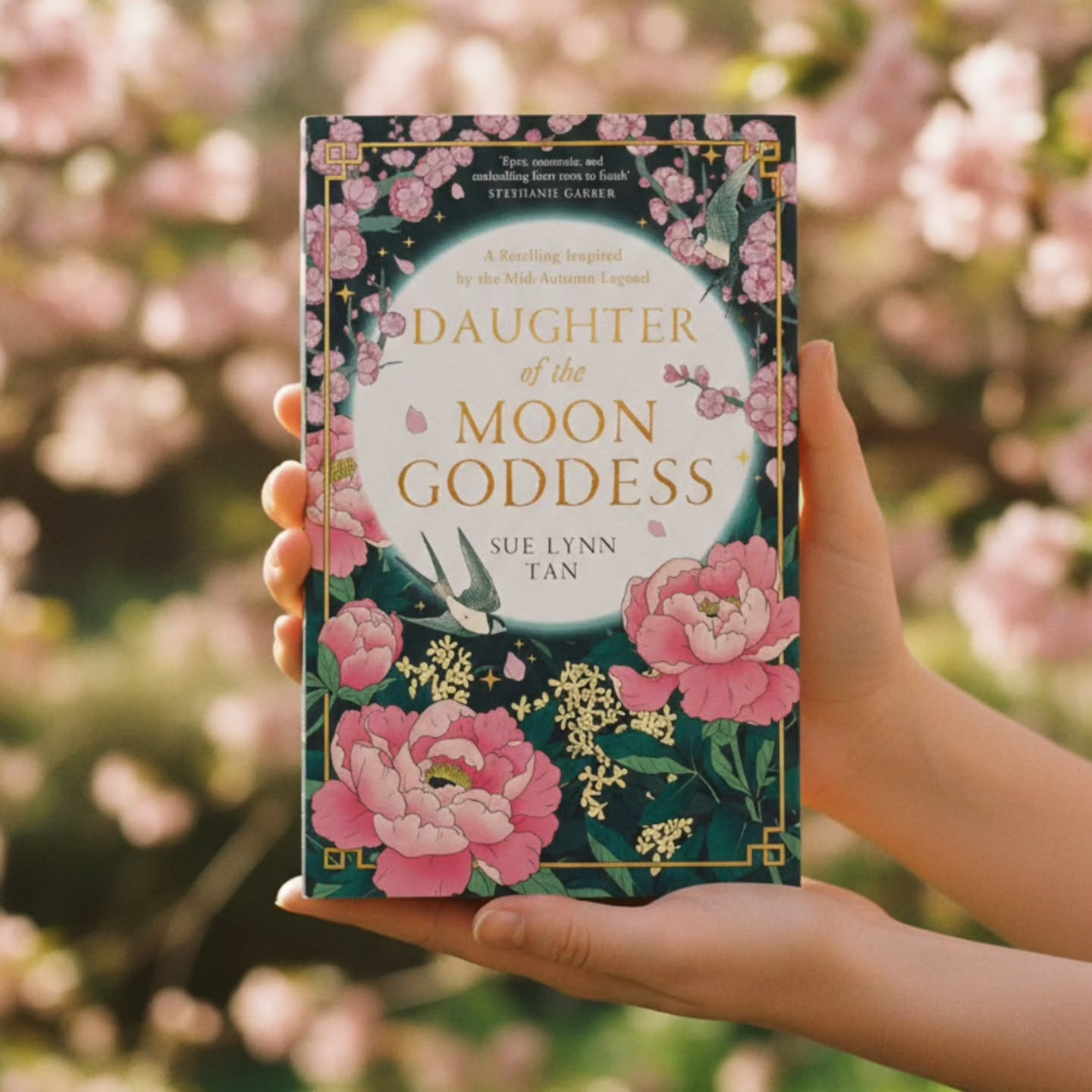
Daughter of the Moon Goddess
-------------------------------------
Author: Sue Lynn Tan
Published: 2022
Genre: English
-------------------------------------
IBC Editorial Rating: 4/5
This book is handpicked by the IBC Editorial Team. If you are an author, publisher, or reader and would like to have a book reviewed by IBC, you may reach us at editorial@indianbookclub.com — we’ll be happy to review it.
-------------------------------------
Editorial Review:
In this enchanting debut inspired by the legend of Chang'e, the Chinese moon goddess, Sue Lynn Tan weaves a sweeping epic fantasy of immortals, forbidden magic, and impossible choices. Xingyin has spent her entire life hidden on the moon, unaware that her exile protects her from the ruthless Celestial Emperor who banished her mother for stealing his elixir of immortality. When her latent magic betrays her existence, she must flee her lunar sanctuary, leaving her imprisoned mother behind. Alone and powerless in the celestial realm, Xingyin disguises her identity and finds herself training alongside the emperor's son, mastering archery and magic while navigating forbidden attraction. To rescue her mother, she embarks on a perilous quest that will pit her against legendary creatures, treacherous enemies, and ultimately the emperor himself. Blending ancient mythology with romantic adventure, this captivating tale explores the collision between duty and desire, the price of freedom, and the courage required to challenge those who wield absolute power.
-------------------------------------
Book Summary:
Xingyin's childhood on the moon is one of beautiful isolation. Raised by her mother Chang'e in their celestial refuge, she knows only the silvery landscape of the lunar palace and the loving presence of the woman who has sacrificed everything to keep her safe. What Xingyin doesn't fully comprehend is the danger that necessitates this seclusion: her mother's theft of the Celestial Emperor's immortality elixir resulted in permanent exile to the moon, and the emperor's wrath would extend to any offspring discovered. For years, this arrangement has provided safety through obscurity, a peaceful if lonely existence removed from the politics and perils of the celestial realm. This fragile security shatters when Xingyin's dormant magical abilities suddenly manifest. The flare of power acts as a beacon, revealing her presence to those who would inform the emperor. With discovery imminent and her mother's punishment certain to intensify if Xingyin is found, Chang'e makes an agonizing choice: she urges her daughter to flee, to save herself even if it means separation. Xingyin, heartbroken but obedient, leaves the only home she's known, embarking on a journey to the Celestial Kingdom with the determination to one day return and free her mother. Arriving in the celestial realm powerless, alone, and terrified of discovery, Xingyin must navigate a world of wonder and danger far beyond her limited experience. The Celestial Kingdom dazzles with its magnificent palaces, enchanted forests, and powerful immortals, but beneath the beauty lurks a constant threat. Xingyin conceals her true identity—revealing herself as Chang'e's daughter would mean immediate capture—and through a combination of courage and fortune, secures a position that allows her to remain near the seat of power. Her circumstances take an unexpected turn when she gains opportunity to train alongside Prince Liwei, the Celestial Emperor's son. What begins as strategic positioning—learning the skills necessary to eventually challenge the forces keeping her mother imprisoned—evolves into something more complex. As Xingyin masters archery and develops her magical abilities, she discovers genuine camaraderie and growing attraction with the prince. Liwei proves to be not merely his father's heir but a person of integrity and kindness, someone who sees Xingyin's worth beyond her carefully constructed facade. The romance that develops between them is fraught with impossibility. Beyond the obvious class difference—she is a disguised commoner while he is imperial heir—lies the fundamental incompatibility of their positions: he is son to the emperor who destroyed her family, and she harbors secrets that, if revealed, would make her his enemy. Yet passion flames between them despite these barriers, creating emotional complexity as Xingyin balances her mission against her heart. To achieve her ultimate goal of freeing her mother, Xingyin must undertake a quest that will test every skill she's acquired and every limit of her courage. She confronts legendary creatures drawn from Chinese mythology, faces enemies both mortal and immortal, and navigates political intrigue where allies and adversaries wear interchangeable faces. Each challenge brings her closer to the confrontation she both seeks and dreads: standing against the Celestial Emperor himself. When treachery threatens the kingdom and forbidden magic resurfaces, Xingyin finds herself at the center of conflicts larger than her personal quest. The choices she faces are impossible: she can pursue her dream of rescuing her mother, but doing so might require sacrificing her love for Liwei and potentially plunging the realm into chaos. Alternatively, she can protect the kingdom and the man she's come to care for, but at the cost of abandoning her mother to eternal imprisonment. The narrative builds toward a climactic confrontation where Xingyin must make a dangerous bargain with the emperor, putting everything she values at risk. Tan weaves together the personal and political, showing how individual choices ripple outward to affect entire realms, and how the courage to act despite impossible odds can reshape destinies.
-------------------------------------
Key Takeaways:
- "Filial Devotion and Sacrifice": The novel's emotional core is Xingyin's relationship with her mother and her unwavering determination to free Chang'e from imprisonment. This devotion drives every choice Xingyin makes, even when pursuing her mother's freedom requires sacrificing her own happiness and safety. Tan explores how love manifests as action and sacrifice, how the bonds between parent and child can sustain through separation, and how honoring those we love sometimes means enduring unbearable costs. - "Identity and Disguise": Xingyin's journey involves constant performance—hiding her true parentage, concealing her motives, presenting carefully curated versions of herself to survive in hostile environments. The novel examines how identity operates when authenticity means danger, how we negotiate between our true selves and the personas circumstances require, and what happens when the masks we wear begin to feel more real than the faces beneath. - "Love Versus Duty": The romance between Xingyin and Liwei embodies the classic conflict between personal desire and larger obligations. Their attraction exists in constant tension with their respective duties—his to his kingdom and family, hers to her imprisoned mother and quest for justice. Tan refuses easy resolutions, instead showing how genuine love complicates rather than simplifies moral choices, and how the heart's desires often conflict with honor's demands. - "Power and Its Abuses": The Celestial Emperor represents tyrannical authority that maintains control through fear and disproportionate punishment. Tan explores how absolute power corrupts, how those who wield authority often prioritize maintaining their position over justice or mercy, and how challenging entrenched power requires not just courage but strategic thinking and alliances. - "Mythology as Living Tradition": By weaving Chinese mythological elements throughout the narrative, Tan demonstrates how ancient stories retain relevance and power. The novel functions both as entertaining fantasy and as cultural preservation, introducing readers to legendary creatures, celestial hierarchies, and moral frameworks from Chinese tradition while making them accessible to contemporary audiences.
-------------------------------------
Iconic Lines, Scenes & Characters:
- "The Moon Palace Setting": Tan's descriptions of Xingyin's lunar home create ethereal beauty—the silvery landscape, the isolation, the strange magic of living removed from the mortal and celestial realms. This setting establishes the novel's tone and provides a powerful contrast when Xingyin enters the vibrant, dangerous Celestial Kingdom. The moon palace becomes a symbol of both safety and limitation, representing the protection that also constrains. - "Xingyin's Character Arc": The protagonist evolves from a sheltered, isolated girl to a skilled warrior and strategic thinker without losing her essential compassion and determination. Her resilience in the face of overwhelming obstacles, her refusal to abandon her mother despite years of separation, and her capacity to find strength in vulnerability make her a compelling heroine. She succeeds not by becoming hardened but by maintaining her humanity even as she develops formidable abilities. - "The Archery Training Sequences": Xingyin's development as an archer provides both literal skill acquisition and metaphorical growth. Mastering the bow requires patience, discipline, and precision—qualities that serve her in contexts beyond combat. These training scenes also facilitate her relationship with Liwei, creating intimacy through the shared pursuit of excellence and mutual respect for abilities. - "Liwei as Complicated Love Interest": The prince could have been merely a romantic obstacle or a straightforward hero, but Tan gives him complexity. His position as the emperor's son creates genuine conflict—he's not responsible for his father's actions but benefits from them; he possesses privilege and power that make him simultaneously attractive and problematic as a romantic partner for Xingyin. His character explores how good people can be embedded in unjust systems. - "Mythological Creatures and Challenges": The novel's quest elements introduce creatures from Chinese mythology—dragons, phoenixes, celestial beings—that feel authentic to the cultural source material while serving narrative purposes. These encounters test Xingyin's growing abilities and provide opportunities for demonstrating courage, cleverness, and moral judgment. - "The Mother-Daughter Bond": Despite physical separation for much of the narrative, Chang'e remains central to Xingyin's motivation and identity. Tan portrays this relationship with warmth and depth, showing how parental love shapes us even in absence, how the desire to protect and honor our parents can drive extraordinary action, and how separation intensifies rather than diminishes familial bonds. - "The Celestial Court's Politics": Tan creates a richly detailed political landscape where alliances shift, secrets proliferate, and survival requires reading subtle social cues and navigating competing interests. The court intrigue adds dimension beyond a straightforward quest narrative, showing Xingyin must develop political acumen alongside martial skills. - "Moments of Comfort and Beauty": Despite the high stakes and constant danger, the novel includes scenes of genuine warmth—shared meals, quiet conversations, moments of wonder at the celestial realm's beauty. These interludes prevent the narrative from becoming relentlessly dark and provide emotional grounding that makes the conflicts more affecting.
-------------------------------------
Who Should Read This:
Daughter of the Moon Goddess will particularly enchant readers who love mythology retellings that honor their source material while crafting original narratives. Those familiar with the legend of Chang'e will appreciate Tan's expansion of the myth, while readers new to Chinese mythology will find an accessible introduction to its rich traditions and imaginative possibilities. Fans of romantic fantasy seeking slow-burn relationships complicated by external obstacles and impossible circumstances will find satisfaction in Xingyin and Liwei's connection. The romance develops organically from mutual respect and shared experiences rather than instant attraction, providing emotional investment without overwhelming the adventure and quest elements. Readers who enjoy female protagonists who combine strength with vulnerability will appreciate Xingyin's characterization. She's neither an invulnerable warrior who never struggles nor a helpless figure requiring constant rescue—instead, she's a young woman learning to navigate a dangerous world, making mistakes, experiencing fear, yet persisting through determination and love for her mother. Those seeking comfort reads with high stakes will value the novel's balance between genuine tension and ultimate hopefulness. While dangers are real and losses occur, the overall trajectory points toward triumph, and the narrative voice maintains a warmth that provides reassurance even during difficult passages. This is a fantasy that acknowledges darkness while affirming light's ultimate victory. However, readers seeking radical subversion of fantasy tropes or completely unpredictable plotting may find the narrative somewhat conventional. As noted, certain plot developments follow familiar patterns—the enemies-to-lovers elements, the quest structure, the final confrontation with tyrannical authority. The novel's strength lies in execution and cultural specificity rather than genre innovation. Those preferring morally complex, ambiguous narratives may find the ethical frameworks relatively straightforward. While Tan complicates individual characters, the larger moral architecture distinguishes clearly between just and unjust authority, between genuine love and mere attraction. Readers seeking grey-area ethics and difficult moral questions without clear answers should adjust expectations. Readers who struggle with multiple mythological names and celestial hierarchies may find the world-building occasionally overwhelming. Chinese mythology includes elaborate systems of divine and immortal beings, celestial courts, and legendary creatures that require attention to track. Those preferring simpler fantasy worlds with minimal cultural and mythological infrastructure might feel lost. Those uncomfortable with young adult romantic elements—the first-love intensity, the focus on attraction and developing relationships, the relatively chaste physical intimacy—might prefer adult fantasy with more explicit content or less romantic focus. The novel centres on a young woman's coming-of-age alongside her quest, which aligns with YA sensibilities even when marketed to broader audiences. Readers exhausted by chosen-one narratives or protagonists with hidden heritage might find familiar territory. While Tan executes these elements well, Xingyin's story follows recognizable patterns—the hidden princess, the special abilities, the destiny to confront tyrannical power. The cultural grounding and specific characterization distinguish the execution, but the underlying structure remains conventional. Ultimately, Daughter of the Moon Goddess rewards readers seeking beautifully written fantasy that centres on family love, cultural tradition, and romantic longing in equal measure. It's for anyone who wants to be transported to celestial realms filled with magic and wonder, who believes in the power of determined individuals to challenge unjust systems, and who finds satisfaction in stories where love—both romantic and familial—ultimately triumphs. This is a book that feels like both adventure and homecoming, offering the comfort of archetypal fantasy patterns executed with cultural specificity and genuine heart. While perhaps following predictable trajectories in plot, it distinguishes itself through Tan's expressive prose, authentic cultural grounding, and the creation of a protagonist whose resilience and compassion make her journey deeply affecting. It's mythology retelling as both preservation and innovation, honoring ancient stories while making them speak to contemporary desires for representation, agency, and the enduring belief that courage and love can overcome even celestial tyranny.
************************
IBC Editorial Note:
This review is part of the Indian Book Club’s editorial initiative to spotlight books that inspire, inform, and leave a lasting impact on readers. Every title featured is carefully handpicked and reviewed by the IBC Editorial Team to maintain quality, authenticity, and literary value. If you are an author, publisher, or reader and would like to submit a book for review, we’d be delighted to hear from you. Please write to us at: editorial@indianbookclub.com Our team personally evaluates each submission, and selected books are featured as official IBC Editorial Reviews on our platform.
************************